Beautiful Plants For Your Interior
¿Por qué los cables de aluminio cobreado (CCA) no son adecuados para proyectos agrícolas a largo plazo? Análisis de las ventajas de los cables de cobre puro
Modern agriculture increasingly relies on grow‑light systems, greenhouse lighting and automated farm equipment. A stable, dependable power supply is the cornerstone for multi‑year equipment operation.
When sourcing cables for planting projects, many buyers only focus on upfront procurement expense while overlooking long‑term stability under harsh field conditions. Copper‑Clad Aluminum (CCA) cables draw interest for their low purchase price. Even so, pure copper cables deliver much higher reliability for agricultural installations designed for long‑term continuous operation.
Agricultural projects feature wide installation coverage, long operating cycles and expensive on‑site maintenance. Cable faults trigger costly repairs, degrade grow‑light output and disrupt normal crop production schedules. That makes selecting durable cables a critical project decision.
Tadiran supplies heavy‑duty pure‑copper cabling built for commercial grow‑light systems. Visit Tadiran Cable Product Category >>]
Agricultural cabling works under far harsher conditions than ordinary indoor household wiring. Whether deployed in open‑air growing zones or greenhouses, cables endure persistent environmental stressors:
Within commercial grow‑light systems, lamps run for extended cycles according to crop requirements, and cabling must sustain stable power delivery year after year.
Poor‑performing cable materials degrade over time: rising conductor resistance, increased line power loss, and overheating at connection joints may occur. In severe cases, the whole grow‑light system will suffer unstable performance.
For farm projects, cables are not merely simple connecting accessories — they are key components that define the whole system’s service lifespan.
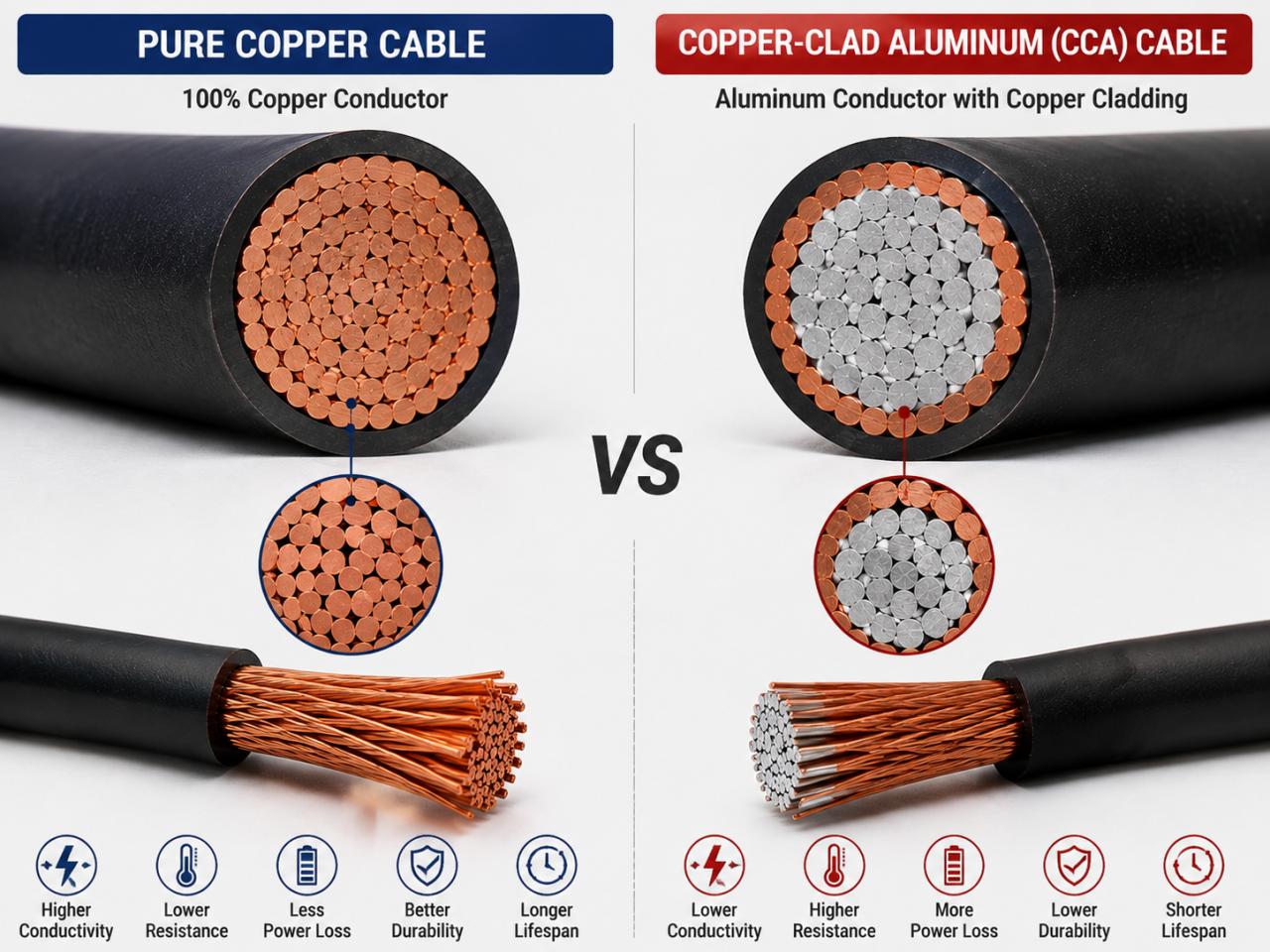
Copper‑Clad Aluminum (CCA) cables adopt an aluminum core wrapped with a thin outer copper layer. Their biggest advantage lies in low initial cost, yet they carry notable drawbacks for multi‑year farm deployment.
First, aluminum has lower electrical conductivity compared with copper. Under identical current load, CCA cables need larger wire gauges to match pure‑copper performance. Without adequate conductor size, excessive line power loss will appear.
Second, farming sites maintain high humidity and frequent moisture exposure. Aluminum is chemically more active than copper and highly susceptible to oxidation. Damaged outer sheaths or imperfect joints expose the inner aluminum core, triggering gradual material deterioration and declining electrical performance.
Additionally, agricultural sites often feature extremely long cable runs. Repair or full cable replacement requires high labor cost and forces unwanted production downtime.
Although Copper‑Clad Aluminum cuts your upfront purchase bill, project planners must weigh significant long‑term maintenance risks for installations meant to operate reliably for multiple growing seasons.
Pure copper cables employ solid copper conductors to maintain consistent electrical characteristics and extended service life.
Copper offers superior electrical conductivity, lowering circuit resistance and power loss to deliver steady power supply for LED grow lights. Its material properties remain stable through years of continuous operation with minimal performance degradation.
For both greenhouse and open‑air agriculture, pure‑copper cabling brings these core benefits: ✅ Stable power transmission ✅ Reduced line power loss ✅ Lower on‑site maintenance frequency ✅ Extended overall service life for the complete grow‑light installation
This consideration weighs especially heavy on large‑scale commercial projects for pitaya, blueberries, strawberries, flowers and other supplementary‑light‑dependent crops. Once laid, replacing field cables incurs substantial cost. Investing in premium pure‑copper cables at project launch effectively reduces future maintenance burdens.
Tadiran pure‑copper cables are engineered for harsh agricultural environments with a minimum service life of 7 years. Browse Tadiran agricultural pure‑copper cables >>]
Agricultural cultivation projects operate on multi‑year timelines. Long‑term stable system value outweighs one‑time procurement spending.
Cheap low‑grade cables may trigger circuit failures after several years, bringing three major losses:
When selecting matching wiring for commercial grow‑light systems, comprehensively assess service life, electrical safety and total long‑run operating costs.
Pure‑copper cables call for higher initial capital outlay. Nevertheless, outstanding conductivity, mechanical stability and durability deliver reliable protection for your long‑term agricultural production.
For long‑run agricultural cultivation projects (open‑air or greenhouse), cable quality directly determines the stability of your entire lighting system.
Copper‑Clad Aluminum (CCA) cables enjoy obvious price advantages, yet they are not the optimal choice for every application. For continuously‑operated grow‑light systems, pure‑copper cables provide more stable power transmission, longer working lifespan and reduced subsequent maintenance overhead.
Choosing high‑quality cabling safeguards stable operation for your farm for many planting seasons ahead.