Beautiful Plants For Your Interior
Choose the best LED grow light for shade-loving mosses, ferns, and green walls. Learn wattage density (5–8W/m²), low-intensity full-spectrum balance, fixture shapes, and photoperiod rules.
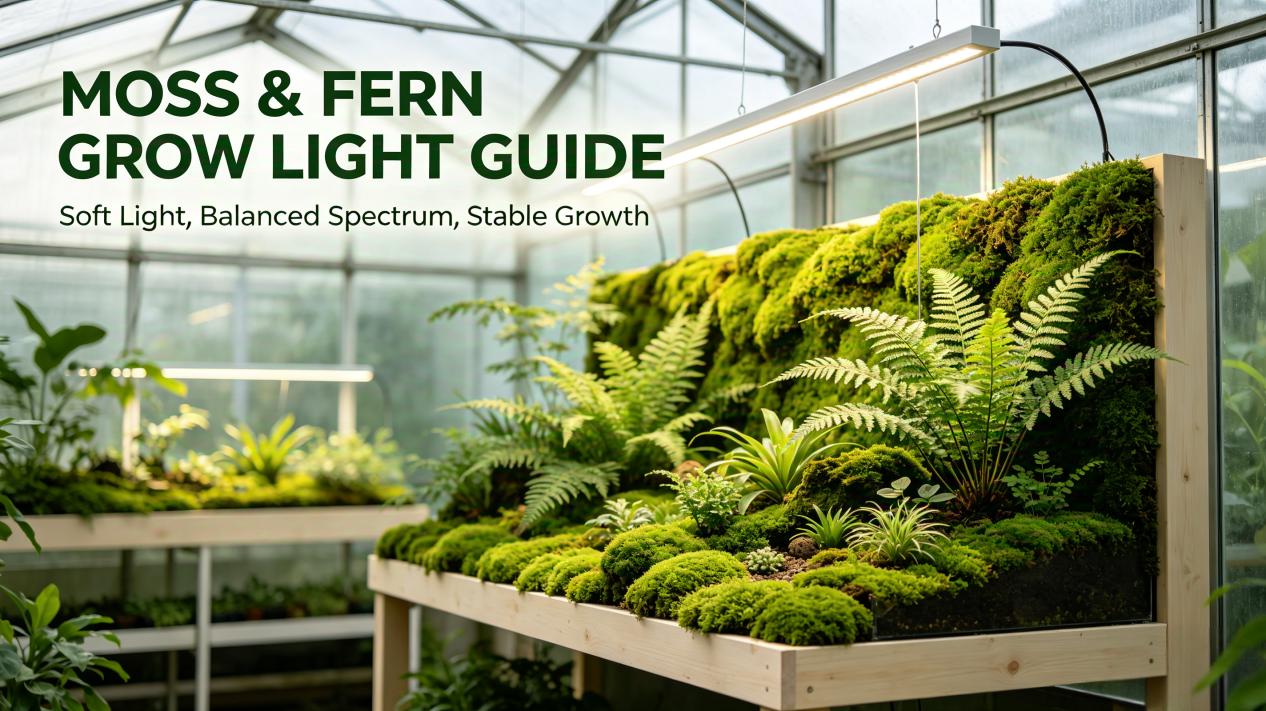
Guía completa de selección de luces de cultivo para musgos y helechos: Iluminación suave, espectro equilibrado y crecimiento estable.

Mosses and ferns are quintessential shade-loving, humidity-seeking foliage plants (plantas de follaje) widely cultivated in greenhouse landscaping, terrariums, vertical green walls, and indoor micro-landscapes. Unlike high-light fruit or vegetable crops, these species thrive under soft, scattered understory light and cannot tolerate harsh, direct sunlight.
Lighting imbalances quickly damage shade-tolerant foliage:
To preserve vibrant green textures and structural stability, dedicated low-intensity grow lights (luces de cultivo de baja intensidad) are essential. This universal selection guide details proper wattage specifications, fixture designs, spectral functions, and practical maintenance rules.
Mosses and ferns belong to low-light foliage categories (plantas de poca luz) that require significantly lower PPFD levels and power density than flowering or fruiting crops.
The standard baseline power density is 5W to 8W per square meter, prioritizing soft and ultra-uniform light distribution over raw intensity:
Unlike high-yield production lighting, moss and fern lighting focuses on long-term, low-brightness steady photon supplementation rather than high-intensity radiation.
Matching fixture geometries with creeping moss carpets and clustered fern architectures ensures uniform growth:
| Fixture Type | Key Features & Advantages | Best Application Scenarios |
|---|---|---|
| Linear Strip Lights (barras LED de cultivo) | Elongated, flat emission surface; delivers even light distribution without hot spots. | Vertical green walls (jardines verticales), multi-tier shelving, and long moss carpet beds. |
| Quantum Boards | High spatial uniformity and broad radiation spread across wide footprints. | Standalone greenhouse corners, micro-landscape studios, and grouped potted ferns. |
| LED Tube Lights (tubos LED para cultivo) | Diffused, glare-free output mimicking understory forest canopy light. | Indoor architectural displays and tissue culture propagation rooms. |
Tadiran provides engineered full-spectrum LED grow lights tailored for indoor foliage plants, commercial green walls, and humidity-controlled greenhouse environments. Maintain lush foliage texture with energy-efficient solutions.
Because non-vascular mosses and ferns feature lower photosynthetic capacities than higher plants, they thrive under a balanced full-spectrum recipe with low blue ratios and moderate red bands:
Implementing targeted supplemental lighting resolves common physiological issues including leaf yellowing, frond elongation, thinning, and slow growth rates.

To ensure long-term health, growers must follow established operational guidelines:
Moss and fern grow lights (luces LED para musgos y helechos) prioritize soft emission, balanced spectral ratios, and steady low-intensity supplementation. Their primary design objective is to maintain compact plant structures, vibrant leaf colors, and dense foliage layers year-round.
By selecting correct wattages, fitting form factors, and deploying full-spectrum LED fixtures, commercial growers and interior landscapers can maintain everlasting green aesthetics, maximizing the commercial value of indoor foliage displays.
Los musgos y helechos son plantas de sombra y alta humedad (plantas de poca luz) que requieren una intensidad de luz muy baja (densidad de potencia de 5–8W/m²). La luz directa o continua causa amarillamiento y quemaduras, mientras que la falta de luz provoca tallos débiles y despoblación. Las **barras LED de espectro completo de baja intensidad** (fotoperiodo de 8–10 horas diarias e impermeabilidad IP65) garantizan un crecimiento compacto, verde intenso y duradero en jardines verticales, terrarios y paisajes de interior.