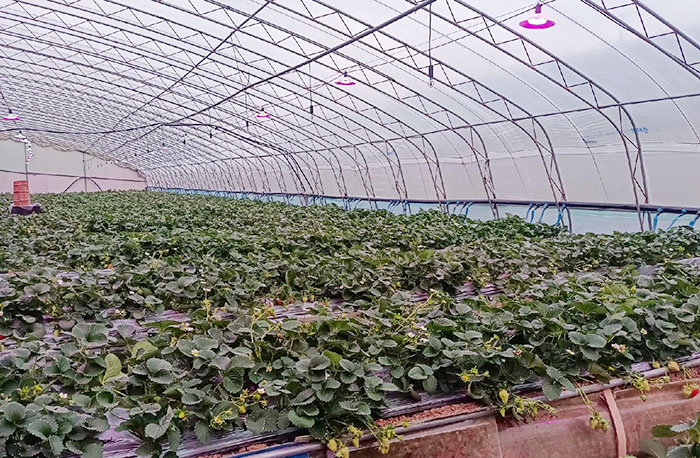
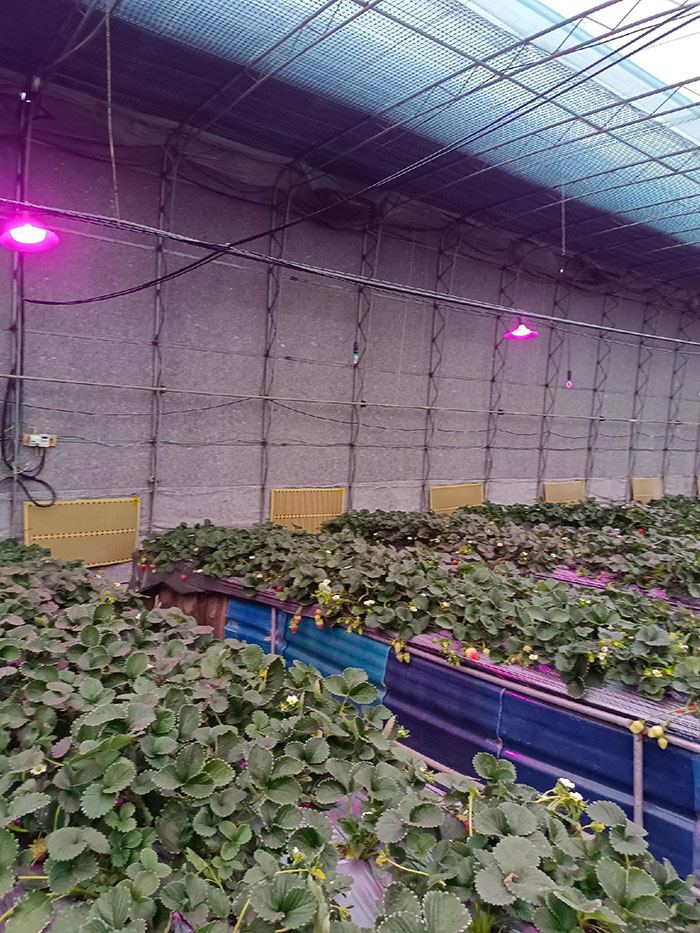
Strawberry Grow Light & Luz LED para Fresas: Complete Greenhouse Guide
Choosing the right strawberry grow light (luz LED para fresas) is essential for commercial berry producers aiming for year-round high yields. When growing under low winter natural light in greenhouses across South America and globally, applying high-efficiency supplemental lighting—such as those detailed in our FruitGrowLight company overview—can increase winter strawberry and frutilla production by up to 50% while improving fruit expansion, coloration, and sugar content.
1. Critical Timing for Strawberry Supplemental Lighting
To optimize photosynthetic photon flux density (PPFD) efficiency using a professional strawberry grow light system, supplemental lighting strategies should target two distinct growth phases:
- Flower Bud Differentiation Stage (Autumn / Late September to November): Photoperiod regulation (day length control) during autumn directly increases the quantity and structural quality of flower buds formed, establishing the overall harvest potential.
- Flowering, Fruit Set & Ripening Stage (Winter / December to March): Natural sunlight is weakest in winter when plant energy demand peaks. Installing a targeted strawberry grow light setup counters low ambient intensity, improves fruit set rates, accelerates berry expansion, and boosts Brix (sugar) levels during prolonged cloudy or foggy weather.
2. Recommended Lighting Schedule & Photoperiod Management
A balanced strawberry grow light photoperiod schedule avoids photoinhibition while maintaining high carbon fixation efficiency:
- Day Extension (Primary Strategy): Extend daylight by illuminating early morning (5:00 AM – 8:00 AM) and late evening (4:00 PM – 8:00 PM) to achieve a total photoperiod of 12–16 hours.
- All-Day Daytime Lighting: During severe overcast conditions when daylight falls below the plant light compensation point (<100 μmol/m²/s), run your strawberry grow light fixtures continuously during daytime hours.
- Midday Shut-Off: Deactivate artificial lamps during peak natural daylight to save operational energy costs.
- Avoid Over-Lighting: Ensure plants receive a dark period for natural respiration; 24-hour continuous lighting causes growth disorders.
3. Choosing the Right Light Source: LED vs. HPS vs. Fluorescent
Comparing lámparas de cultivo and lighting technologies helps calculate long-term return on investment (ROI):
| Lighting Technology |
Spectral Flexibility |
Efficiency & Heat Output |
Commercial Suitability |
| LED Strawberry Grow Light (Preferred Choice) |
Tunable spectrum (Red:Blue ratio 5:1 to 7:1) or full-spectrum options. Ideal luz LED para fresas y frutillas. |
High photoelectric efficiency, lowest electricity costs, low heat output allowing close canopy placement. |
Best choice for commercial greenhouses. Long lifespan & lowest operating cost. |
| High-Pressure Sodium (HPS) |
Narrow spectrum (dominated by yellow-orange light; lacks blue/violet). |
High luminous efficacy but excessive heat output; requires higher mounting height. |
Traditional option; provides auxiliary ambient heat in winter but incurs higher energy usage. |
| Fluorescent (T5/T8) |
Broad, low-intensity spectrum. |
Low overall optical efficacy. |
Suitable primarily for propagation trays; ineffective for commercial fruiting canopy light supplementation. |
4. Light Intensity & Canopy Target Requirements
According to research on agricultural plant physiology standards, strawberry lighting parameters must be carefully calibrated:
- Strawberry Compensation Point: Approx. 30–50 μmol/m²/s (~1,000–2,000 Lux).
- Strawberry Saturation Point: Approx. 500–800 μmol/m²/s (~25,000–40,000 Lux).
- Target Supplemental PPFD: Maintain 150–300 μmol/m²/s (~8,000–15,000 Lux) at the top of the canopy using your strawberry grow light system.
- Measurement Standard: Always utilize a dedicated PAR meter to measure PPFD (μmol/m²/s) rather than relying solely on Lux meters.
5. Fixture Installation & Spatial Layout Guidelines
- LED Mounting Height: Position LED strawberry grow light bars 50–80 cm above the canopy to avoid light attenuation or thermal stress.
- HPS Mounting Height: Mount HPS fixtures at least 1.5 meters above the canopy to prevent heat damage.
- Grid Layout: Space fixtures in a uniform grid layout to eliminate shaded zones. Angle fixtures vertically downward to maximize beam coverage.
6. Integrated Environmental Management
To fully capitalize on your high-performance strawberry grow light system, integrate lighting with climate control:
- Temperature & Humidity: Maintain daytime temperatures between 18–25°C and night temperatures at 5–10°C. Keep relative humidity around 60%–70%.
- CO2 Enrichment: High PPFD accelerates CO2 consumption. Elevate greenhouse CO2 levels to 800–1,000 ppm to drastically increase photosynthetic rate.
- Fertigation Control: Increase water, phosphorus, potassium, and calcium delivery to support rapid cell division and fruit development.
Optimize Your Greenhouse Lighting Strategy
Looking to upgrade your greenhouse grow light infrastructure with high-efficiency full-spectrum LED solutions?
Contact our technical sales team: tadiran@tatalux.com
Explore our specialized spectrum technology: Pitaya / Pitahaya Grow Lights, Luz LED para Fresas, Solución de Iluminación Suplementaria, and Custom Commercial Greenhouse Luminaires.