Beautiful Plants For Your Interior
Beautiful Plants For Your Interior

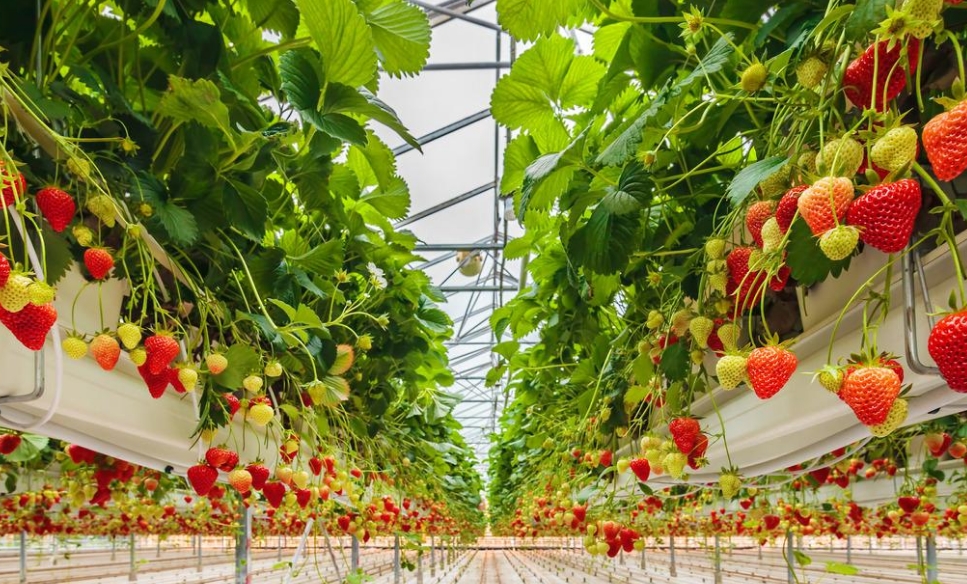
When engineering an indoor vertical farm or commercial greenhouse, agricultural operators frequently ask: how far should LED grow lights be from plants to achieve maximum crop yields without burning leaf tissue? In the highly optimized sectors of modern indoor vertical farming, large-scale commercial greenhouses, and intensive crop cultivation facilities, managing the spatial distribution of light is just as critical as selecting the light spectrum itself. Implementing a state-of-the-art LED grow light grid requires a massive deployment of capital, making it vital to maximize every single watt of energy drawn from the grid.
For international agricultural supply procurement directors, greenhouse developers, and B2B cultivation consultants reviewing manufacturing capabilities on commercial platforms like FruitGrowLight, hanging height is not a matter of guesswork. It is a precise mathematical science rooted in quantum physics and crop physiology. Incorrect positioning directly leads to catastrophic operational losses, ranging from localized leaf bleaching and stunted yields to massive energy waste caused by photon spillover onto walkways instead of the plant canopy.
Historically, legacy lighting systems like High-Pressure Sodium (HPS) fixtures had to be hung exceptionally high above the crop canopy—often three to four feet away—to prevent intense radiant infrared heat from burning the plant tissue. However, modern solid-state arrays completely alter the rules of indoor climate and layout management. This technical engineering evaluation directly answers the most critical operational question faced by indoor cultivation facility designers: how far should LED grow lights be from plants? By breaking down canopy-level target metrics, spatial photon distribution profiles, and structural hardware configurations across different growth phases, this comprehensive guide gives commercial growers a bulletproof blueprint for higher yield consistency and a faster return on investment (ROI).
To capture Google Featured Snippets and provide immediate, actionable answers to commercial project planners, this section establishes the industry-standard rules for physical fixture layout. When calculating how far should LED grow lights be from plants, the standard commercial distance ranges from 12 to 36 inches (30 to 90 cm) depending entirely on the crop’s growth phase, the system’s total electrical wattage, and the targeted Photosynthetic Photon Flux Density (PPFD) requirements.
Because modern fixtures do not project intense forward infrared heat toward the canopy, they can be hung significantly closer to plants than older gas-discharge bulbs. During the early seedling and cloning stages, a commercial LED grow light should be placed farther away, around 24 to 36 inches, to prevent delicate young tissues from suffering light shock. As crops transition into the vegetative stage, the distance should be shortened to 18 to 24 inches to drive vigorous structural growth. Finally, during the heavy flowering and fruiting cycles, the fixtures are typically lowered to 12 to 18 inches (or run at 100% intensity via a dimmer) to maximize deep photon penetration into the lower canopy layers, which directly accelerates total crop harvest weights.
To maximize the operational profitability of an industrial indoor farm when determining how far should LED grow lights be from plants, agricultural operators must continuously balance the physical distance between the fixtures and the moving canopy top. Each biological stage requires a highly specific quantum density:
Understanding how far should LED grow lights be from plants in a professional indoor farm requires a basic look at the physics of light travel. The primary law governing how light intensity drops over distance is the Inverse-Square Law. This principle states that the intensity of light landing on a surface is inversely proportional to the square of its distance from the source ($I \propto 1/d^2$).
If a greenhouse technician accidentally doubles the distance between an LED grow light and the top of the canopy (for instance, moving it from 12 inches up to 24 inches), the plants do not just lose half the light. The available photon intensity actually drops by a massive 75%, leaving the crops with only one-quarter of the original growing power. In a large commercial facility operating across thousands of square meters, this minor physical misalignment can lead to massive drops in yield and a significant waste of expensive electricity. To combat this, modern industrial facilities deploy multi-bar fixtures that distribute light across an array of chips, allowing the lights to be hung much closer to the canopy to achieve perfectly uniform coverage without creating dangerous central hotspots.
| Crop Growth Stage | Hanging Distance (Inches) | Hanging Distance (Metric) | Target Canopy PPFD Range | Commercial Operational Goal |
|---|---|---|---|---|
| Seedling / Microgreens | 24″ – 36″ | 60 cm – 90 cm | 100 – 300 μmol/m²/s | Prevents light shock and fosters early root system development. |
| Vegetative Growth | 18″ – 24″ | 45 cm – 60 cm | 300 – 600 μmol/m²/s | Promotes short node stacks and thick, sturdy stem architecture. |
| Flowering / Fruiting | 12″ – 18″ | 30 cm – 45 cm | 600 – 1000+ μmol/m²/s | Drives maximum biomass accumulation, fruit sizing, and brix scores. |
| Leafy Greens (Full Cycle) | 16″ – 22″ | 40 cm – 55 cm | 250 – 350 μmol/m²/s | Maintains steady, rapid crisp leaf output without edge burn risks. |
Achieving perfectly uniform yields across massive commercial setups requires more than just knowing basic distance numbers. It demands an industrial manufacturing partner that designs smart hardware solutions to tackle real-world farming challenges. FruitGrowLight is a premier global B2B manufacturer and high-volume OEM/ODM supplier specializing in high-efficacy, full-spectrum LED grow light equipment built specifically for heavy-duty industrial farming operations.
Our product lines use advanced multi-bar configurations rather than old-fashioned central spotlights. When clients consult us regarding how far should LED grow lights be from plants in multi-tier vertical racks, our engineering team demonstrates how our multi-bar arrays spread high-quality Samsung and Osram chips evenly across a wide frame. This allows growers to hang the lights much closer to the crop canopy, maximizing photon delivery while keeping light distribution uniform. Additionally, all of our industrial lines feature built-in, continuous 0-10V dimming controls. This allows facility managers to leave their overhead light framing at a fixed, permanent height, adjusting light intensity electronically to match different crop growth stages with a simple dial, saving valuable maintenance labor hours.
When you choose FruitGrowLight as your long-term commercial OEM partner, you unlock a comprehensive suite of professional B2B services:
Quality control and international compliance are the bedrock of our business. Sourcing commercial lighting equipment for strict regulatory markets requires absolute adherence to rigorous safety standards. The vast majority of our commercial LED lines carry official CE marking (CE-EMC and LVD) certifications. This compliance guarantees that our internal drivers emit zero electromagnetic interference to block surrounding automated farm systems or sensors, while ensuring safe low-voltage operation for absolute peace of mind in the field.
If you see leaf bleaching—where upper leaves closest to the diodes turn pale yellow or pure white—your fixtures are hung too close. You should immediately raise your LED grow lights by 6 to 12 inches (or dim the intensity by 20–30%) to allow the chlorophyll to recover and prevent further stunted growth.
Traditional COB or spotlight designs focus their photon output into a concentrated central beam, requiring a hanging distance of 24 to 36 inches to avoid creating a destructive hotspot. In contrast, modern multi-bar fixtures from FruitGrowLight spread diodes out across a broad aluminum frame, allowing you to safely lower the fixtures down to 12 to 18 inches without risking heat or light damage.
Yes, this is the preferred approach for modern, automated commercial facilities. By utilizing the advanced 0-10V dimming controllers built into FruitGrowLight systems, you can secure your light frames permanently at a fixed high position. You can then simulate different hanging distances electronically—running at 20% intensity for seedlings, 60% for veg, and 100% for peak flowering—saving your maintenance staff hundreds of manual labor hours.
If your lights are hung too high along the outer rows of a facility, the wide light beam spreads past the edge crops and spills onto the surrounding walls and walkways. This photon spillover represents wasted energy. Utilizing detailed Dialux simulations from our engineering team allows you to calculate exact perimeter mounting angles and lower heights, ensuring every single photon is directed onto the crop canopy.
Absolute safety is vital when workers constantly adjust hanging frames in high-humidity greenhouse environments. LVD certification proves the light features robust low-voltage insulation to eliminate electric shock risks. Meanwhile, CE-EMC certification ensures that adjusting or dimming the power drivers will not emit electromagnetic noise to block surrounding automated climate sensors or wireless facility equipment.
Mastering how far should LED grow lights be from plants allows commercial facility managers to eliminate photon spillover and maximize yield potential. Stop letting poor hanging distances and inefficient, high-heat legacy fixtures burn through your facility’s profit margins and unevenly stunt your crop development. Upgrade your commercial cultivation facility with modern, multi-bar solid-state technology designed for perfectly uniform canopy delivery. Whether you are building out a multi-tier vertical farm, upgrading a massive glass greenhouse, or sourcing high-demand inventory for an international B2B distribution network, FruitGrowLight delivers the manufacturing scale, international compliance, and field reliability your business demands.
To request a complete Dialux photometric canopy mapping or factory-direct wholesale pricing, contact our technical B2B consulting team at info@fruitgrowlight.com or send us a message directly to request a custom OEM quote.
Scan QR code to chat with our grow light specialist!