Beautiful Plants For Your Interior
Facing poor growth after installing LED growlights? Discover common supplemental lighting mistakes in PPFD, mounting height, spectrum choice, and photoperiod management for commercial crops
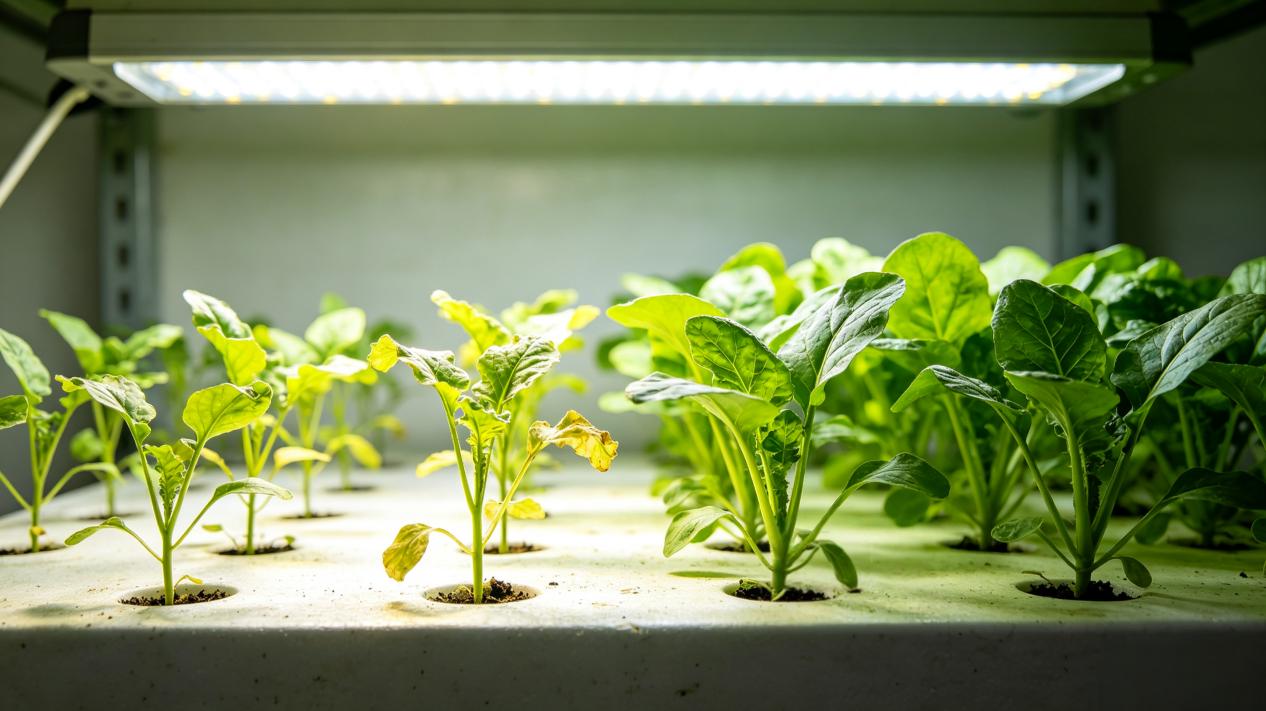
Errores comunes en los sistemas de luces LED de cultivo: ¿Por qué las plantas no crecen bien incluso después de instalar iluminación artificial?

The way we grow plants is changing rapidly with the advancement of protected agriculture. LED growlights (Luces LED de cultivo) have become an essential component of modern greenhouse cultivation, indoor farming, and commercial crop production. More and more growers are deploying supplemental growlight systems to optimize plant growing environments, boost yields, improve crop quality, and achieve reliable year-round production.
However, many growers find that after installing LED growlights, their plants are not growing as well as expected. This disappointing outcome is rarely due to defective fixtures. A professional plant growlight project (luz para crecimiento de plantas) is a multi-variable engineering task that involves lamp efficiency, spectral configuration, mounting height, light-to-canopy distance, daily photoperiod, and ambient environmental management.
If growers focus solely on mounting lights without accounting for these critical variables, they will fail to achieve their desired return on investment (ROI).
This is the most common mistake growers make when purchasing plant growlights. Many choose LED growlights based on power consumption, assuming a 100W lamp is inherently superior to a 50W lamp. However, plants do not absorb electrical power—they absorb photosynthetically active photons that hit their leaves.
Several key parameters determine the actual volume of usable light plants receive:
For example, two 100W LED lamps can produce vastly different light outputs. One fixture may concentrate light over a tiny area, while another features specialized secondary optics to evenly distribute photons across a broader canopy.
When designing commercial growlight systems, growers must prioritize parameters like PPFD (Photosynthetic Photon Flux Density)—which measures actual photons delivered to the plant—rather than simply comparing electrical wattage.
The mounting height of LED growlights directly impacts light coverage and photon density. Incorrect positioning compromises the overall performance of the lighting system:
The optimal installation height depends on fixture wattage, beam angle lens design, crop growth stage, and target PPFD requirements.
Plant species and growth stages require distinct light spectrums. Using an incorrect spectral profile severely hampers plant development. Substituting commercial growlights with standard white indoor lighting often leads to poor results because residential fixtures lack targeted wavelengths required for efficient photosynthesis.
Key spectral bands and their primary agricultural functions include:
Selecting an uncalibrated spectrum can cause stem etiolation, weak structure, poor flowering, and diminished fruit yield.
Tadiran LED growlights feature crop-friendly, scientifically formulated spectrums optimized for greenhouse, outdoor orchard, and fruit cultivation applications, ensuring maximum light utilization efficiency and stable yields.
A frequent misconception is that extending lighting hours indefinitely will continuously accelerate crop growth. In reality, plants require dark periods to execute essential metabolic cycles and cellular respiration.
Prolonged, uninterrupted lighting disrupts natural biological rhythms and lowers light energy utilization efficiency. Photoperiod requirements vary greatly by crop type:
Lighting schedules should always be customized based on crop variety, growth phase, and ambient natural light duration.
Supplemental growlight projects often fail when designed in isolation from site-specific environmental conditions. A lighting strategy that succeeds in one geographical region may underperform in another.
Key environmental factors to integrate into system design include:
A scientific supplemental lighting plan is designed to complement natural sunlight shortages, not blindly replace natural solar radiation.
Simply hanging a set number of lamps across a greenhouse does not constitute a properly engineered growlight system. Inadequate fixture layout creates light hotspots and dark zones, leading to uneven crop height, staggered ripening, and inconsistent harvest quality.
Large-scale commercial installations require pre-planned grid layouts, calculated row spacing, optimized mounting heights, and precise electrical distribution plans based on 3D light coverage simulation analysis.
Plant light requirements change continuously as crops mature. For example, seedlings require lower PPFD to establish root systems safely, while mature plants in the generative phase require high light intensity and specific spectrum ratios to support flower bud differentiation and rapid fruit enlargement.
Operating a static lighting regime from germination through harvest prevents LED growlights from reaching their full potential. Lighting duration, intensity, and spectral output should be dynamically adjusted to match crop growth stages.
LED growlights provide a powerful tool to optimize crop growth environments, but they are not a “set-and-forget” technology. Achieving superior growth performance requires a holistic engineering approach combining target PPFD, custom spectrum design, strategic fixture positioning, tailored photoperiod schedules, and sound crop management.
As precision agriculture continues to evolve, intelligent LED supplemental lighting systems are becoming indispensable across commercial greenhouses and modern orchards worldwide.
Instalar luces LED de cultivo no garantiza el éxito si no se consideran factores técnicos clave. Los errores más comunes incluyen enfocarse en la potencia eléctrica (vatios) en lugar de la intensidad de luz real (PPFD), colocar las lámparas a una altura incorrecta, elegir un espectro inadecuado, descuidar la distribución uniforme en el campo y no adaptar las horas de luz (fotoperiodo) al tipo de cultivo y su etapa de crecimiento.