Beautiful Plants For Your Interior
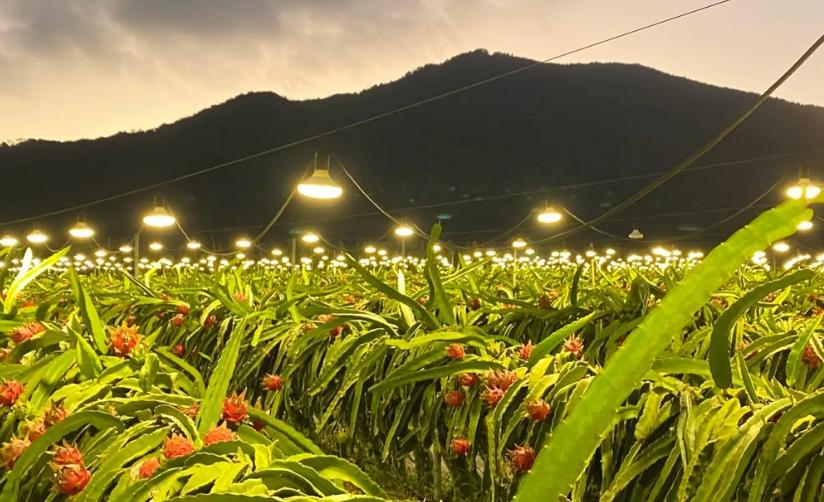
Análisis de luces de cultivo superiores frente a luces laterales para el cultivo de pitahaya
With continuous advances in LED grow‑light (luz LED para cultivo) technology, artificial supplemental lighting has become a critical production tool for more and more commercial pitaya orchards to stabilize harvest yields.
In real‑world farm deployment, besides lamp wattage and light spectrum, grow‑light mounting layout greatly determines final lighting performance. Two mainstream installation schemes are widely applied for pitaya planting: top‑mounted lighting and side‑mounted lighting.
Pitaya (pitahaya) has special trailing branch architecture. What practical differences exist between top and side grow‑light installation? Which layout delivers better performance for large‑scale commercial pitaya cultivation?
Tadiran supplies professional LED grow‑light solutions for pitaya plantations, including both overhead top‑lighting and side‑lighting systems. Explore Tadiran Pitaya Grow‑Light Products >>]
Top‑mounted grow‑light layout is the most widely adopted configuration within modern commercial agriculture. LED fixtures are installed above crop canopies, casting illumination vertically downwards onto plants.
Its biggest advantage is simulating natural sunlight, which always shines from above. It creates a familiar, natural light environment for pitaya vegetation.
Top lighting brings two prominent benefits for pitaya growing:
For that reason, top‑mounted lighting is the common and cost‑effective primary option for large‑scale commercial pitaya plantations.
Side‑mounted grow‑light installation places LED fixtures beside plant rows, projecting light horizontally into crop canopies.
As pitaya matures, its long branches stretch outward and hang downwards naturally. Overlapping foliage easily creates shaded inner‑canopy and lateral‑branch zones. Side lighting improves light exposure for these shadowed positions and optimizes localized light conditions.
This layout fits specific planting scenarios:
Nevertheless, relying purely on side lighting as main system for large‑scale pitaya orchards brings obvious downsides: it requires far more lamp units, higher material investment and much more complex field installation work.
Side‑mounted lighting seldom serves as primary lighting infrastructure. It mostly acts as auxiliary optimization tool responding to special planting requirements.
The fundamental gap originates from light penetration direction into pitaya canopy.
Top lighting addresses overall plantation‑level light requirements. It covers the whole field from overhead and maintains stable photoperiod signals. Featuring simple installation and broad coverage, it perfectly matches standardized large‑scale agricultural production.
Side lighting solves localized light shortage. Horizontal supplementary light compensates shadowing caused by overlapping pitaya branches. Although helpful for special canopy conditions, it is rarely chosen as main lighting solution for big commercial pitaya farms.
For pitaya growers targeting better flowering rate and stabilized output, uniform whole‑orchard light coverage carries higher priority than high light intensity on partial individual branches.
Top‑mounted lighting should be the priority choice for most commercial pitaya orchards.
The core objective of pitaya grow‑light(luz LED para cultivo de pitahaya) is not pursuing maximum light intensity on every single branch. Instead, it delivers steady photoperiod growth signals. Top‑mounted lighting features broad coverage, straightforward system layout and convenient cabling, well‑adapted for large‑scale outdoor pitaya cultivation.
Side‑mounted lighting can be deployed as supplementary measure for resolving local insufficient light. It works great for high‑density planting, special trellis frameworks or scenarios needing further light optimization.
When designing LED supplemental‑lighting systems for pitaya, growers need to comprehensively evaluate planting acreage, row spacing, plant architecture, local power‑supply status and lighting targets, rather than arbitrarily picking one single installation pattern.
Tadiran develops professional commercial LED grow‑lights tailored for pitaya cultivation, supplying both overhead top‑lighting kits and side‑lighting solutions. Check Tadiran pitaya grow‑light system options >>]
Taking pitaya cultivation as the research case, top‑mounted lighting and side‑mounted lighting are not mutually‑exclusive competing solutions. Each fits distinct practical farm scenarios.
Top‑mounted lighting imitates natural sunlight with wide coverage, and acts as primary lighting choice for most commercial pitaya orchards. Side‑mounted lighting remedies local shaded spots and performs best as auxiliary optimization solution.
Reasonable lighting layout design must match crop growth traits plus real‑site orchard conditions. Only with proper installation configuration can LED grow‑light systems fully boost vegetative growth and flower‑induction performance for pitaya.