Beautiful Plants For Your Interior
Beautiful Plants For Your Interior

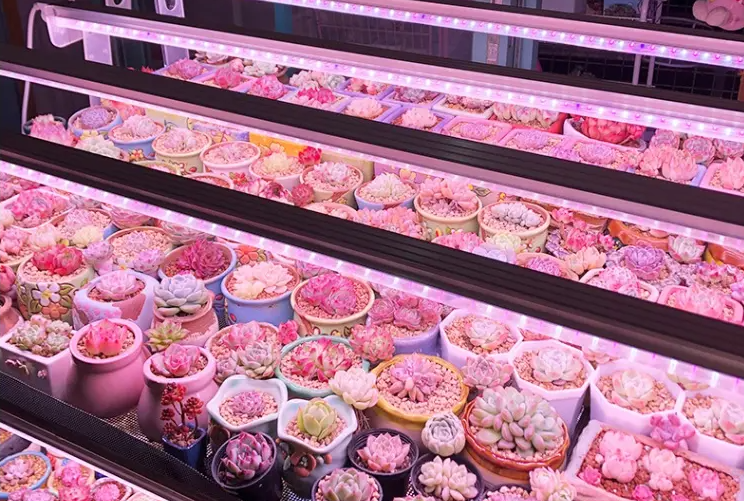
For large-scale commercial ornamental nurseries, vertical plant-shelf distributors, and professional interior plantscape consultants, maintaining the aesthetic perfection of indoor foliage is essential to business value. Transitioning from natural window-lit spaces to climate-controlled indoor environments requires deploying high-efficiency horticultural systems. Selecting a premium **led grow lights for succulents** setup serves as the primary engineering solution to guarantee compact growth structures, enhance rich leaf pigmentation, and eliminate seasonal leaf drop or aesthetic decay.
When purchasing agents and wholesale botanical distributors review industrial component options on specialized manufacturing platforms like Fruitgrowlight, they must recognize that low-to-medium light crops demand precise parameter control. Over-lighting or utilizing improper spectral distributions can easily scorch delicate tropical leaves or cause vibrantly colored succulents to revert to a dull, stretched green appearance.
Historically, low-power consumer grow bars caused sub-par plant results. They frequently caused severe stretching (etiolation) in indoor plants because they lacked sufficient Photosynthetically Active Radiation (PAR) output and precise blue photon balancing. Modern commercial horticultural engineering has eliminated these structural deformities through broad-spectrum white matrices, optimized secondary optics, and dynamic low-heat thermal designs.
## Field Technical Benchmark: LED Grow Lights for Succulents and Houseplants
To capture immediate technical validation for large-scale indoor facility layouts, this section establishes the selection benchmark for low-to-medium intensity applications. When evaluating the effectiveness of **led grow lights for succulents** and tropical foliage, specialized full-spectrum LED grow light fixtures are highly effective when they deliver a precise Photosynthetic Photon Flux Density (PPFD) of **100 to 300 μmol/m²/s** and incorporate a high blue-to-red spectral ratio to prevent stretching while stimulating the production of vibrant anthocyanin and carotenoid pigments without causing heat stress.
Unlike high-energy agricultural crops like tomatoes or medicinal plants, tropical houseplants and desert succulents have unique physiological adaptations to light:
* **Low-Light Houseplants (Calatheas, Monsteras, Pothos):** Native to forest understories, they can suffer severe leaf scorching under intense, unfiltered light.
* **Desert Succulents:** Require moderate-to-high light levels but are extremely sensitive to incorrect spectral balances. Without sufficient blue photons, they rapidly stretch out, ruining their prized compact aesthetic.
Utilizing advanced solid-state LED systems allows commercial growers to provide uniform light coverage and ideal spectral mixes. This approach maintains compact, vibrant plants while reducing energy costs and avoiding high localized temperatures.
## Preventing Etiolation and Inducing Pigmentation in Succulent Species
To optimize a commercial vertical nursery or retail display for maximum visual appeal, growers must control two key physiological processes: etiolation prevention and pigmentation enhancement.
### 1. Eradicating Etiolation (Stretching)
When desert succulents or compact houseplants do not receive enough light, they undergo etiolation—a survival mechanism where stems rapidly stretch toward the nearest light source. This creates thin, weak cell walls, wide leaf spacing, and an unattractive appearance that severely reduces commercial value. To prevent this, a targeted LED grid must provide a strong blue light channel (450 nm). This specific wavelength activates cryptochrome photoreceptors, which slow down stem elongation and keep the plant growing in its compact form….To prevent this, installing automated led grow lights for succulents provides a strong blue light channel (450 nm).
### 2. Inducing Vibrant Pigmentation
When configuring led grow lights for succulents, bringing out rich purple and red anthocyanin pigmentation requires a targeted spectrum…The deep reds, purples, and pinks that make succulents popular are driven by protective pigments called [anthocyanins](https://en.wikipedia.org/wiki/Anthocyanin). Plants produce these compounds to protect their tissues from excess photon stress. To bring out these rich colors indoors, a grow light must deliver a high-quality full spectrum with precise deep-red (660 nm) wavelengths at a moderate-to-high light intensity (250–350 μmol/m²/s). This careful balance triggers natural color adaptation without drying out leaves or damaging root systems.
## Custom Spectrum Tuning for Low and Medium Light Indoor Houseplants
Designing an effective indoor lighting system for tropical houseplants requires moving away from harsh “blurple” (blue + red) spectrums. Because these plants are often grown in living spaces, commercial offices, or vertical retail racks, lighting must support healthy plant biology while providing excellent visual clarity for human eyes.
Fruitgrowlight’s custom full-spectrum systems use high-color-rendering (CRI > 90) white LED chips mixed with targeted deep-red diodes. This specialized combination provides a wide band of green and yellow wavelengths (500–600 nm). Green light penetrates deep into dense leaf canopies, supporting lower-leaf photosynthesis while providing comfortable, natural white light for staff to check for pests and manage plant health without eye strain.
## Commercial Ornamental Lighting Specification and Metric Matrix
| Plant Category & Examples | Target PPFD Range | Optimal Daily DLI | Photoperiod (Hours) | Primary Spectral Requirements |
| :— | :— | :— | :— | :— |
| **Low-Light Houseplants**<br>*(Calathea, Pothos, Snake Plants)* | 60–120 μmol/m²/s | 4–6 mol/m²/day | 12–14 Hours | Gentle Full Spectrum White; avoids high red channels to prevent leaf burn. |
| **Medium-Light Houseplants**<br>*(Monstera, Ficus, Philodendron)* | 120–200 μmol/m²/s | 6–10 mol/m²/day | 14–16 Hours | Balanced Full Spectrum with moderate green light for deep leaf canopy penetration. |
| **Green Succulents & Cacti**<br>*(Haworthia, Jade Plants, Aloe)* | 180–250 μmol/m²/s | 10–14 mol/m²/day | 14 Hours | High Blue (450 nm) channel to maintain compact cell shapes and prevent stretching. |
| **Pigmented Succulents**<br>*(Echeveria, Sedum, Graptopetalum)* | 250–350 μmol/m²/s | 14–18 mol/m²/day | 14–16 Hours | High-Intensity White + Deep-Red (660 nm) to trigger vibrant coloration. |
| **Tissue Culture & Propagation**<br>*(Foliage Micro-cloning)* | 50–100 μmol/m²/s | 3–5 mol/m²/day | 16 Hours | Blue-Enhanced low-wattage grids to promote strong early root and shoot growth. |
## Fruitgrowlight Premium Horticultural OEM Manufacturing Standards
Maintaining high visual quality and healthy growth across multi-tier retail racks or vertical commercial farms requires partnering with an experienced horticultural manufacturer. Fruitgrowlight is a leading global B2B manufacturing leader and professional OEM/ODM supplier with deep export experience, providing durable, high-efficacy LED grow light solutions to commercial nurseries, retail facility developers, and international agricultural equipment distributors around the world.
We build our commercial product lines using premium SMD diodes, heavy-duty IP65 waterproof aluminum housings, and reliable dimmable industrial drivers. Every production batch undergoes comprehensive integrating sphere tests, thermal endurance checks, and long-term waterproof validation.
When you partner with Fruitgrowlight as your OEM supplier, you gain access to:
* **Custom Spectral Optimization:** Customized red, blue, white, and far-red ratios matched to exact crop varieties.
* **Pre-Sales Support & Dialux Simulation:** Detailed PAR maps and Dialux lighting simulations calculating exact mounting heights.
* **Complimentary Packaging & Branding:** Custom retail packaging layouts, technical instruction manuals, and corporate branding integration.
* **Streamlined Supply Chain Logistics:** Global component tracking and export logistics for safe, on-time delivery.
Our commercial product lines carry official CE-EMC and LVD certifications, guaranteeing zero electromagnetic interference with municipal networks while ensuring absolute electrical safety.
## Frequently Asked Questions (FAQ)
### Can standard household LED bulbs be used as led grow lights for succulents?
No. Standard household LED bulbs are designed only for human vision and lack the targeted blue (450 nm) and deep-red (660 nm) photon wavelengths that drive plant photosynthesis and shape development. Standard bulbs lack the photon energy and spectral balance required to prevent succulents from stretching or to maintain rich leaf colors.
### How does a blue-heavy spectrum prevent indoor houseplants and succulents from becoming leggy?How do blue-heavy led grow lights for succulents prevent plants from becoming leggy?
Plants track light quality using photoreceptors called cryptochromes. When these receptors absorb sufficient blue light (450 nm), they signal the plant to reduce stem growth and strengthen cell walls, resulting in thick, compact stems and dense foliage.
### What are the primary signs that a tropical houseplant is receiving too much light intensity?What are the signs that tropical houseplants under led grow lights for succulents are receiving excess light?
Low-light tropical plants show clear symptoms: bleached or yellowing spots on upper leaves, crisp brown edges (tip-burn), or leaves curling downward to hide from light. If these occur, lower light intensity using an integrated dimmer or raise the fixtures higher above the canopy.
### Why is an IP65 waterproof rating necessary for commercial nursery lights?
Indoor nurseries require frequent top-watering, automated misting, and liquid fertilizing, creating high humidity. Non-rated lights collect internal moisture, causing short circuits and hardware failure. IP65 rated fixtures utilize silicone seals to protect internal components in wet commercial spaces.
### Why are CE-EMC and LVD certifications critical for indoor nursery equipment?
Commercial facilities use automated computerized valves, ventilation fans, and wireless sensors. CE-EMC certification proves grow lights will not cause electromagnetic interference with surrounding equipment, while LVD certification guarantees wiring safety in humid growing environments.
## Conclusion
Protect your retail inventory quality and commercial display value by switching to high-efficacy solid-state technology designed for uniform PAR distribution and vibrant plant coloration. Fruitgrowlight delivers production scale, international CE compliance, and rugged field reliability for vertical nurseries and wholesale networks.
To explore custom lighting configurations or request a Dialux PAR map layout simulation, contact our B2B technical consulting team at **info@fruitgrowlight.com** or send us a message directly to request a custom OEM quote.
Scan QR code to chat with our grow light specialist!